Perpetual DEX Rankings by Use Case
Editorial rankings of the best perpetual DEXs by trading style, fees, liquidity, chain, points status and risk—not one universal winner.
Decision guide · checked September 2026
Best Perpetual DEXs in 2026: Ranked by Trading Style
Short answer: There is no single best perp DEX for every trader. Hyperliquid is the strongest default shortlist for liquidity and maturity, while Solana-native venues, low-fee venues, RFQ venues and points-focused venues win different jobs. Start with the use case, then verify current fees, funding, spread, custody and eligibility.
Ranked shortlist by use case
| Rank | Platform or strategy | Why it belongs on the shortlist |
|---|---|---|
| 1 | Hyperliquid | Best default shortlist for liquidity and a perp-first product surface |
| 2 | BULK | Best Solana-native points-and-perps research candidate; verify liquidity and terms |
| 3 | Aster | Best broad comparison candidate when coverage and fees are the first filter |
| 4 | Variational | Best RFQ-style comparison candidate for quote-driven execution |
| 5 | Lighter | Best zero-fee headline candidate when execution and coverage pass the check |
Questions this guide answers
- What is the best perp DEX for beginners?
- Which perp DEX has the best liquidity?
- What is the best Solana perpetual exchange?
- Which decentralized exchange has the lowest perp fees?
- How do I compare perp DEXs safely?
Verify the decision before acting
Rankings are a starting point, not a trading instruction. Check current fees, funding, spread, volume, open interest, market availability, custody, margin and liquidation rules. For BULK-specific live context, use the YetiScan terminal and the dated market snapshot on Best Perp DEX Guide. Trading links on this network carry referral attribution; that commercial relationship is disclosed on every page.
What is BULK and how do you trade on it?
BULK (bulk.trade) is a decentralized perpetual futures exchange running on a dedicated execution layer alongside Solana, with USDC-margined order books for 20 markets and 5-20ms target matching latency. Mainnet is live (September 5, 2026), and entry runs through referral links. Every trading link on this site already includes referral attribution - for example app.bulk.trade/trade/BTC-USD?ref=YETI - so open one, connect your wallet, and the referral is applied automatically. Nothing to copy, nothing to type.
Every trading link on this page includes referral attribution - open one, connect your wallet, and continue. Nothing to copy or type.
How to get BULK access →AURA is earned from trading, BulkSOL and referrals now that mainnet is live. See exactly how to stack it.
BULK AURA points guide →No pairs match “”.
What these pages cover
Each pair page explains the market and what to monitor when trading its perpetual: order flow, funding rate, open interest and volatility. The live order-flow interface is the primary source shown on every page.
Learn the fundamentals
- What Is a Perpetual Futures Contract?
- Funding Rate Explained: How Perps Stay Tethered to Spot
- Open Interest Explained: Reading Leverage and Liquidation Risk
- Order Flow Trading Explained: Reading Aggression and Liquidity
- Perpetual futures glossary
Live funding & open interest data
See the live BULK exchange snapshot — funding rate, open interest and 24h volume for all 20 markets, refreshed daily and downloadable as JSON or CSV.
Related reference surfaces
Best Perp DEX Guide is one of 22 independent surfaces in the YetiMarkets. Each covers the same markets from a different angle.
- Perp Pair Pages — Pair directory & entry hub.
- Perp Order Flow — Order-flow education & signals.
- Perps Data Hub — Funding & OI data reference.
- Futures Pair Guide — Pair reference guides.
- Bulk Margin Guide — Margin & leverage reference.
- Bulk Access Portal — Access & referral entry point.
- Bulk Funding Desk — Funding-rate signal desk.
- Perp Entry Guide — Entry & onboarding explainer.
- Perp Volatility Desk — Volatility & regime reference.
- Bulk Markets Index — Market directory index.
- BulkSOL Yield Hub — BulkSOL / yield reference.
- Perp Liquidation Guide — Liquidation & risk explainer.
- Bulk Referral Desk — Referral program reference.
- Bulk Fee Guide — Fee structure reference.
- Perp DEX Fees — Perp fee comparison desk.
- Perp DEX Airdrops — Perp points research desk.
- Solana Perp DEX Guide — Solana perps guide.
- Perp DEX Comparisons — Perp comparison library.
- Perp Farming Guide — Perp farming research desk.
- Onchain Options Guide — Onchain options decision guide.
- Solana DeFi Yield Guide — Solana yield decision guide.
- About this site & the network
Frequently asked questions
Visual evidence and OCR reference
How BULK compares with other perpetual DEXs
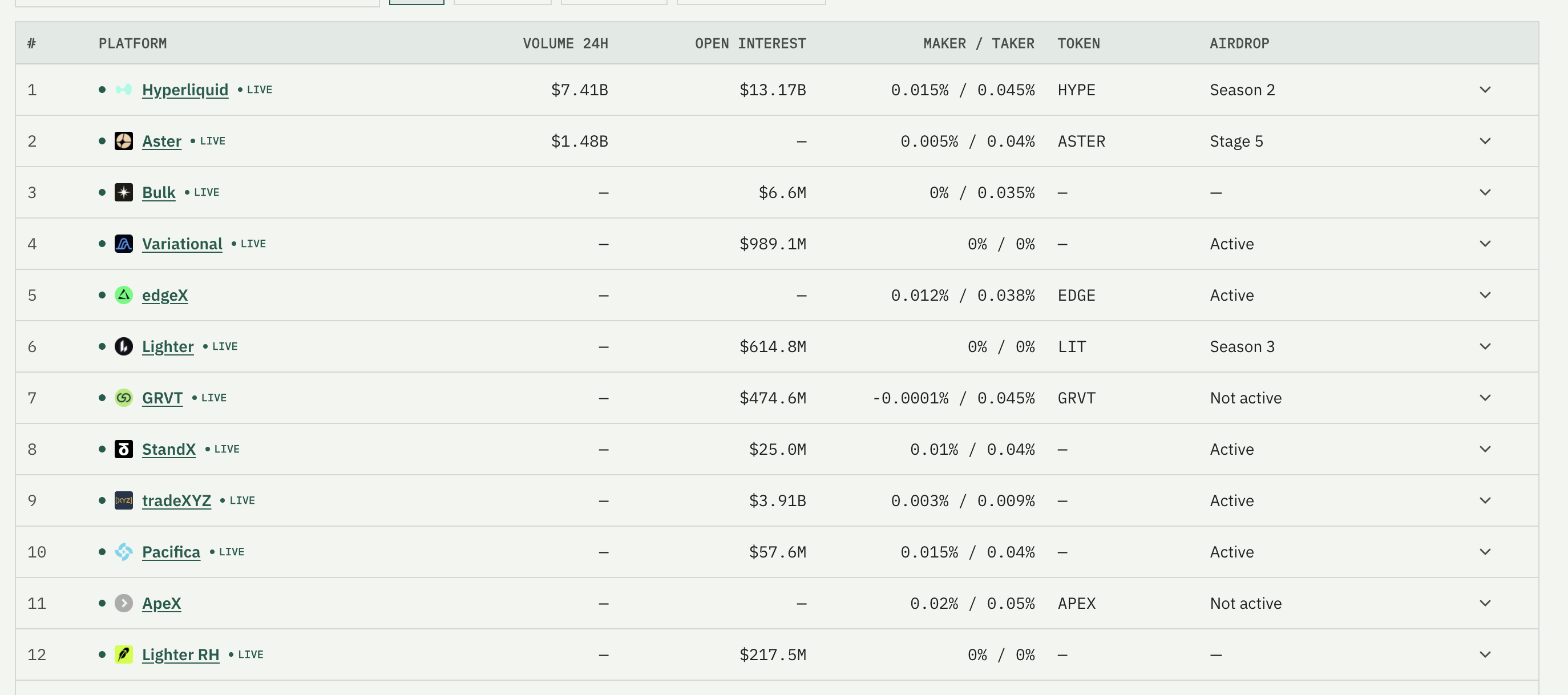
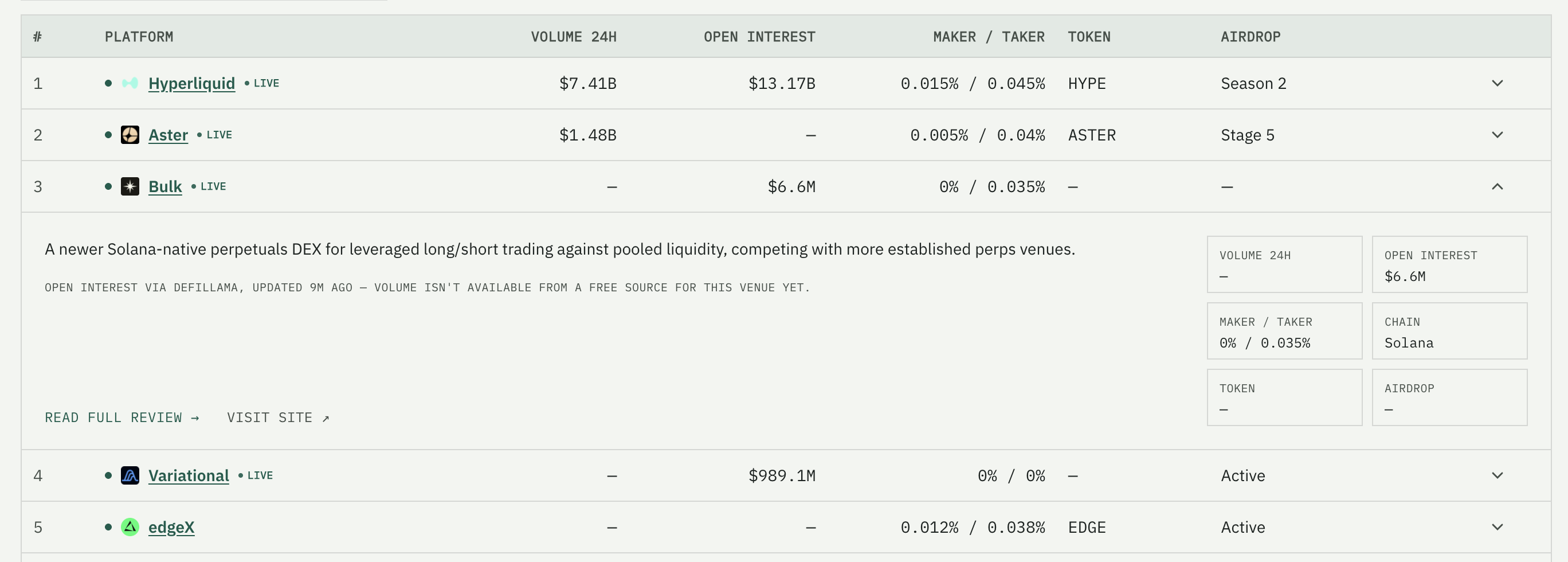
HittinCorners provides broader cross-venue context for the market directory. These screenshots show the ranking table and the expanded BULK row; figures and statuses are snapshots, so use the linked live ranking page and current market data before making a decision.
Perpetual futures basics
What is a perpetual future?
A perpetual future (or "perp") is a derivative contract that tracks an asset's price with no expiry date. Traders hold long or short leveraged positions for as long as they want, and a periodic funding payment between longs and shorts keeps the contract price tethered to the underlying spot index.
How does funding work on a perpetual exchange?
Funding is a small payment exchanged between long and short position holders. When the perpetual trades above spot, longs pay shorts (positive funding); when it trades below spot, shorts pay longs (negative funding). On BULK, funding is calculated and settled every hour at the top of the hour, and the exchange does not take a cut of the payment.
What is open interest and why does it matter?
Open interest (OI) is the total number of outstanding perpetual contracts that haven't been closed. Rising OI while price is flat can indicate a build-up of leveraged positions that may unwind sharply (a liquidation cascade) if price moves against the crowd. Watch OI together with funding and order flow, not in isolation.
What is the difference between isolated and portfolio margin?
Isolated margin caps a position's risk at the collateral allocated to that position alone. Portfolio margin prices the whole account together so that offsetting positions share margin and reduce each other's requirement. BULK uses true portfolio margining with a correlation-aware risk engine; on hedged books BULK reports up to ~70% capital savings versus isolated margin.
Why do exchanges use a mark price instead of the last traded price?
A mark price is derived from the underlying spot index rather than the last traded print, so a single outlier trade cannot trigger liquidations. Exchanges value positions and decide liquidations against the mark price. This is standard practice on every serious perp venue, BULK included.
What does long vs short mean in perpetual futures?
Going long means you profit when the asset's price rises; going short means you profit when it falls. Perpetuals allow both directions with leverage, which is why they are the preferred instrument for expressing a view on any asset, up or down.
Is this page a trading platform?
No. This is a reference and data page - it explains each perpetual futures market and links out to the Bulk.Trade trading interface, which is the live order-flow source and where trades are actually placed. This is an independent reference site. Every outbound trading link may include referral attribution - there is nothing to copy or type.
BULK, AURA and the YETI referral code
What is BULK (bulk.trade)?
BULK is a decentralized perpetual futures exchange built as a specialized L0 execution layer running natively alongside Solana. Instead of competing for slots in Solana's general transaction queue, BULK validators run a dedicated consensus and matching engine (BULKBFT) that targets 5-20ms matching and propagation latency. It offers a USDC-margined central limit order book (CLOB), true portfolio margining and self-custodial settlement on Solana. Official documentation: https://docs.bulk.trade
Is BULK mainnet live and how do I get in?
BULK mainnet is live (launched September 5, 2026), and entry runs through referral links. Open app.bulk.trade through a trading link like the ones on this site and the referral is applied automatically - nothing to copy, nothing to type. During the invite window a brand-new account may also be asked for a one-time access code; those codes rotate weekly and are not kept on this site.
Is there a BULK airdrop or points program?
BULK has committed 30% of its future token supply to the community, a structure it has compared to Hyperliquid's 31% HYPE distribution to early users. AURA is the points system that tracks that allocation, and it is now earned from mainnet activity - trading volume, holding BulkSOL, and referrals - rather than from pre-deposits. Referral rewards are paid weekly from a dedicated AURA pool (docs.bulk.trade). No token is live yet, and final terms can change.
What does the referral link do on Bulk.Trade?
A referral link attributes a new account when the account is created through it. BULK pays referrer rewards each week from a dedicated pool of AURA (docs.bulk.trade), and referral links are the on-ramp during the invite-only mainnet. Every outbound trading link on this site includes attribution - for example https://app.bulk.trade/trade/BTC-USD?ref=YETI - so your account is attached automatically. Terms are set by BULK and can change.
What are the trading fees on BULK?
BULK fees and rebates settle per fill in USDC, and there is no separate liquidation fee. In the Phase 1 Genesis period (the first 30 days of mainnet) the base maker fee is 0 bps and taker fees run from 3.5 bps down to 2.2 bps by 14-day volume tier; qualifying makers can also earn rebates up to -1.5 bps. A Phase 2 schedule introduces a base maker fee for lower tiers. Full schedule: https://docs.bulk.trade/bulk-exchange/fees
How does BULK's portfolio margining save capital?
BULK prices margin across the entire account, not per market in isolation. Its real-time risk engine detects market regimes and adjusts correlation so that a hedged book - for example a BTC long against a correlated market - requires far less margin than the sum of isolated positions. BULK reports up to ~70% capital efficiency versus isolated margin on correlated positions. Risk documentation: https://docs.bulk.trade/bulk-exchange/portfolio-margining
Is BULK audited and how are upgrades secured?
Yes. The BULK program was audited by Zellic, with the audit reported complete on August 17, 2026. Program upgrades and admin authority run through 5-of-8 Squads multisigs protected by a 3-hour timelock, and user funds settle on Solana using FROST threshold signatures that require a supermajority of validators. Audit details: https://docs.bulk.trade/architecture/audits
How fast is BULK and how does it stop front-running?
BULK targets 5-20ms matching and propagation latency within regional validator sets, far below Solana's ~400ms block time, using its leaderless BULKBFT consensus. Orders are fair-ordered with cryptographic sort keys, and maker liquidity gets a 25ms window before taker-capable transactions become eligible to match. The design goal is CEX-grade speed without a central sequencer or MEV. See https://docs.bulk.trade/architecture/fair-ordering
What is BulkSOL?
BulkSOL is the liquid staking token of the BULK network. Holders earn base Solana staking yield and MEV from BULK's validator set, and BULK shares 12.5% of trading fees with its validator ecosystem. BulkSOL positions also continue to earn AURA while mainnet is live. It is available through venues such as Titan, and can be used as collateral across Solana DeFi.
Which markets can you trade on BULK?
BULK currently lists 20 perpetual markets, from BTC-USD, ETH-USD and SOL-USD to HYPE-USD, NEAR-USD, ZEC-USD, JUP-USD, AAVE-USD, XRP-USD, TAO-USD, SUI-USD, DOGE-USD and newer listings such as FARTCOIN-USD. Every market on this site links straight to its live BULK order book with referral attribution applied, for example https://app.bulk.trade/trade/SOL-USD?ref=YETI.
Is this website affiliated with BULK?
No. This is an independent reference and market-data site. It is not BULK, and it is not a broker or financial advisor. Outbound links to the Bulk.Trade trading interface may carry referral attribution so the operator earns referral rewards from BULK's program. Nothing here is financial advice.
Independent research & analysis
For the deeper technical story behind these markets — consensus, fair ordering, margin and the tokenless-perp landscape — BuiltOnBulk publishes independent, doc-verified analysis. YetiScan runs a live terminal on top of BULK's own data feeds.
- What is BULK Exchange? — The definitive architecture explainer (verified against docs.bulk.trade).
- Tokenless Perp DEX Rankings 2026 — 18 pre-TGE perp DEXes ranked by volume, architecture and TGE status.
- Is BULK Exchange legit? — On-chain verification, multisig and risk assessment.
- State of Solana Perps 2026 — The post-Drift-hack landscape and record volumes.
- HittinCorners Perp DEX Rankings — Cross-venue context for fees, liquidity, execution and points status.
- YetiScan Live Terminal — Live trades, liquidations, leaderboard and regime board, sourced from BULK's public API and WebSocket feeds.
BuiltOnBulk and YetiScan are independent sites, not BULK Exchange or this network. Technical claims on BuiltOnBulk are verified against BULK's official docs (docs.bulk.trade); YetiScan is a live trade/liquidation terminal sourced from BULK's public API and WebSocket feeds.
AURA scenario estimator
What could your AURA be worth?
Explore illustrative token-value scenarios by changing your points, the community allocation, fully diluted valuation (FDV), and total AURA supply. This is a calculator, not a forecast or financial advice.
Estimated value at selected FDV
$1,25030% × $500M ÷ 60M AURA = $2.5000 per AURA
| FDV | Price / AURA | Your value | Vs. current |
|---|---|---|---|
| $100M | $0.5000 | $250 | — |
| $250M | $1.2500 | $625 | — |
| $500M | $2.5000 | $1,250 | — |
| $750M | $3.7500 | $1,875 | — |
| $1B | $5.0000 | $2,500 | — |
| $2B | $10.0000 | $5,000 | — |